

OEM Projector Cost: 5 Key Factors and Cost-Saving Strategies
Understanding the drivers behind OEM (Original Equipment Manufacturer) projector costs is critical for businesses launching a private-label brand or engaging in bulk procurement. Controlling these costs directly impacts profit margins and market competitiveness. This article breaks down the five key factors influencing OEM projector cost and provides practical strategies for savings, with a specific focus on LCD technology.
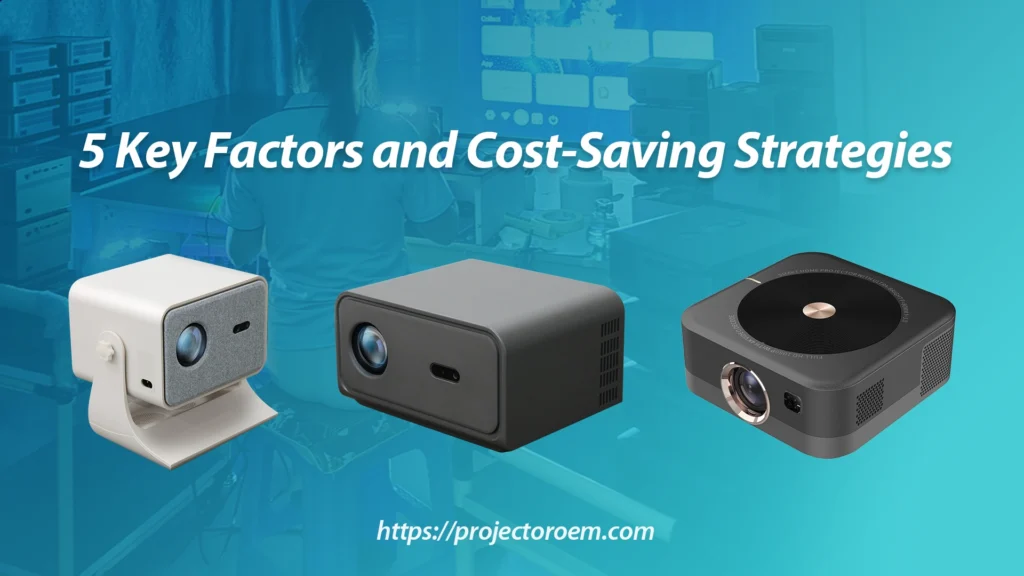
5 Core Factors Affecting OEM Cost for LCD Projectors
1. Optical Engine & LCD Panels
This is the heart of the cost. LCD projectors use transmissive LCD panels (typically 3LCD or single-panel LCD). Costs rise significantly with resolution (e.g., 720p, 1080p, 4K) and panel size. A high-quality 1080p 3LCD optical engine module can be 60%-100% more expensive than a 720p single-panel LCD solution. Panel factors like light transmission rate, heat resistance, and consistency also affect pricing.
2. Light Source Brightness & Type
Brightness (measured in ANSI lumens) is directly tied to cost. For LCD projectors, the primary light sources are traditional Ultra-High-Pressure (UHP) mercury lamps or newer LED systems.
Common ones include:
✅ UHP Lamps: Achieve high brightness (e.g., 4000-6000 lumens) at a relatively lower cost but have a shorter lifespan (~3,000-5,000 hours).
✅ LED Light Sources: Offer much longer lifespan (20,000+ hours) and wider color gamut but are more expensive and technologically complex to achieve the same brightness.
Increasing brightness from 2000 to 3000 lumens can raise the light source cost alone by 25%-40%.
3: Optical Lens & Throw Ratio
Lens quality and functionality are often overlooked cost drivers.
✅ Fixed vs. Zoom Lens: A zoom lens with a flexible throw ratio (e.g., 1.2x-1.5x) costs more than a simple fixed-focus lens.
✅ Lens Shift & Keystone Correction: Lenses with optical (not digital) lens shift capability for easier installation command a premium.
✅ Material & Precision: Glass lenses offer superior sharpness and heat resistance over plastic but increase cost. A short-throw lens design significantly adds to the optical assembly expense.
4. Hardware & Chassis Design
✅ Cooling System: Higher brightness requires more robust cooling (larger heatsinks, multiple fans, optimized airflow design). A quiet and efficient thermal solution adds to the Bill of Materials (BOM).
✅ Chassis & Enclosure: Metal housings improve heat dissipation and durability but cost more than plastic. A custom-designed, compact mold also requires a significant upfront investment.
5. Minimum Order Quantity (MOQ) & Certification
✅ MOQ Impact: This is a fundamental rule. Ordering 500 units will result in a much higher per-unit cost than ordering 5,000 units due to economies of scale in component sourcing, assembly line setup, and labor.
✅ Certifications & Compliance: Costs for mandatory certifications (e.g., FCC, CE, RoHS, FDA for laser components) are fixed. Obtaining these for your brand adds to the initial project cost but is essential for market access.
Cost Comparison: LCD vs. DLP & Laser
Success Factors
While this guide focuses on LCD, it’s helpful to understand the cost landscape:
✅ DLP Projectors: For the same brightness and throw ratio, DLP projectors (using DMD chips from Texas Instruments) typically have a 10-25% higher core engine cost than comparable LCD models. This is due to chip licensing and technology. However, they often have smaller form factors.
✅ Laser Projectors: Laser light sources (especially blue laser + phosphor wheel) are significantly more expensive. A laser-based projector can cost 2 to 4 times more than a lamp-based LCD or DLP model of equivalent brightness. The payoff is an exceptional lifespan (20,000+ hours) and minimal maintenance.
Smart Cost-Saving Strategies for OEM Buyers
✅ Prioritize “Good Enough” Specifications: Avoid over-specing. Do you really need 4K for a budget classroom projector? Opt for 1080p. Is 5000 lumens necessary for a home theater? 1000 ANSI might suffice. Balance performance with your target market’s actual needs.
✅ Leverage Existing Reference Designs: Most OEM/ODM manufacturers offer “reference designs” or semi-custom models. Adapting one of these with your logo and minor tweaks (like port selection) is far cheaper than a fully custom design from scratch.
✅ Optimize MOQ with Standard Components: Work with your manufacturer to use their in-stock, standard components (like a common lens, chassis, or mainboard) where possible. This lowers MOQ requirements and per-unit cost versus requesting fully custom parts.
✅ Plan for Phased Certification: If entering multiple markets, prioritize certifications for your primary market first (e.g., FCC for the US). Add CE (Europe) or others in later production runs to spread out the cost.
✅ Invest in Quality Where it Counts: Don’t cut corners on the power supply or cooling system. These are failure points. A slightly higher initial cost here can prevent massive warranty and brand reputation costs later.
Conclusion
The OEM projector cost is not a single number but a sum of carefully chosen components, volumes, and specifications. By deeply understanding the cost drivers in LCD panels, light sources, optics, and hardware—and by strategically partnering with your manufacturer—you can develop a product that meets both your performance goals and budget constraints. Clear communication, realistic specifications, and smart sourcing are the keys to unlocking value in the competitive projector market.
At Shenzhen DataMax, we specialize in guiding brands through this exact journey. As a professional OEM projector manufacturer with expertise in smart, dust-resistant designs and integrated Google TV systems, we handle everything from collaborative R&D to rigorous quality control and seamless logistics. Let’s discuss how to make your custom projector concept a market-ready success.